





Quantity Surveying in the Middle East: Emerging Trends and Professional Response
Ganga Kuruppumullage B.Sc (QS), HNDE Civil Engineering
Introduction
Over the last twenty years, Qatar and the wider Middle East have experienced significant growth in construction,
fuelled by major infrastructure initiatives, urban expansion, and long-term plans such as Qatar National Vision 2030.
Notable projects, including stadiums, transportation systems, smart cities, and commercial developments, have
heightened the scale, complexity, and financial requirements of construction in the area. In this changing landscape,
Quantity Surveying (QS) has become crucial for managing costs, overseeing finances, and optimizing value throughout
the project lifecycle. With the integration of digital tools, sustainable design practices, and innovative procurement
methods, quantity surveyors now employ Building Information Modelling (BIM), life cycle costing, and green building
standards, establishing themselves as vital players in delivering sustainable and economically feasible projects in
Qatar and the Middle East.
Quantity Surveying in the Middle East Context
Quantity Surveying (QS) in the Middle East particularly in Qatar, UAE, Saudi Arabia, and Oman—has evolved into
a highly specialized discipline shaped by large scale infrastructure programmes, fast track delivery, and contract
heavy project environments. Modern QS responsibilities extend across the full project lifecycle, supporting cost
governance, commercial strategy, procurement assurance, dispute avoidance, and digital transformation (including
5D BIM).
Traditionally, quantity surveyors in the Middle East have played a key role in:
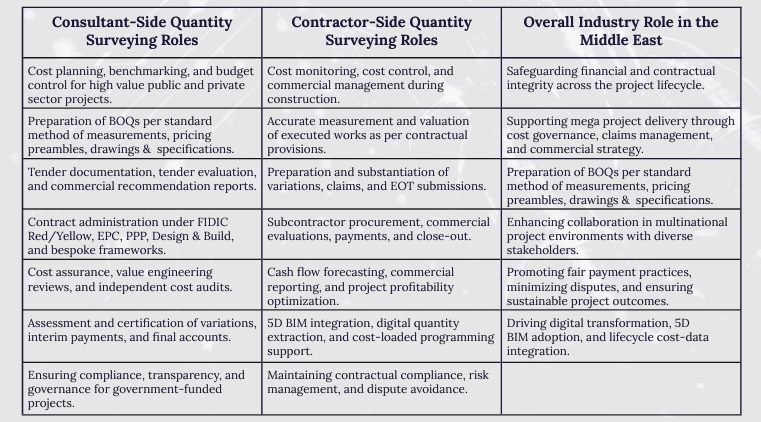
Considering the vast scale and intricate nature of projects in Qatar, which encompass stadiums, transport systems,
and both commercial and residential developments, it is crucial to implement effective cost control and commercial
management. Quantity surveyors, whether they are working on behalf of the client, consultant, or contractor, are
vital in maintaining financial and contractual integrity throughout the entire project lifecycle. Their duties generally
involve cost planning, managing budgets, and preparing Bills of Quantities (BOQs) for various projects, including
buildings, roads, and significant infrastructure, which provide a systematic foundation for precise pricing, tendering,
and resource distribution. Additionally, quantity surveyors participate in the evaluation of tenders, the selection of
contractors, and assist both clients and contractors in maximizing value for money while adhering to contractual and
regulatory standards. Moreover, they manage contract administration, which includes handling variations, claims,
payments, and preventing disputes, under a variety of contracts frequently utilized in Qatar and the broader Middle
East, such as FIDIC, QCS, custom employer-drafted contracts, EPC, PPP, and public sector contractual frameworks.
The creation of interim valuations and final accounts further guarantees fair payment practices and clear financial
reporting throughout the project’s duration.
Key Industry Trends Shaping Quantity Surveying in Qatar and the Middle East
1. Digitalisation and BIM Adoption
1.1 Mandatory BIM Implementation
In Qatar and across the Middle East, the use of Building Information Modelling
(BIM) is increasingly encouraged or required for public-sector, infrastructure, and large-scale construction projects.
Although BIM implementation is not mandatory across all authorities or project types, its adoption is largely
influenced by client requirements, procurement strategies, and project complexity. This trend aligns with national
development objectives, including Qatar National Vision 2030, and seeks to improve project efficiency, transparency,
and lifecycle asset management. Consequently, quantity surveyors are progressively expected to engage with BIM
enabled processes to support cost planning, value management, and lifecycle costing, with the level of adoption
varying across the region.
1.2 Consolidated Traditional Quantity Surveying Responsibilities
In the Middle East, quantity surveyors have historically been crucial in upholding the financial and contractual
integrity of construction projects. Their primary responsibilities encompass:
• Measurement and preparation of Bills of Quantities (BOQs)
• Cost planning and budget management
• Preparation of tender documents, evaluation, and contract administration
• Conducting interim valuations, certifying payments, and finalizing accounts
• Evaluating variations and claims
These roles constitute the technical foundation of the profession and are vital for ensuring cost certainty and financial
discipline throughout the entire project lifecycle.
1.3 The Evolving and Strategic Functions of Quantity Surveyors in the BIM Landscape
With the advent of BIM and digital technologies, the responsibilities of quantity surveyors are shifting from traditional
measurement tasks to more strategic, analytical, and governance-focused roles.
Automated Quantity Extraction and Cost Precision
BIM allows for the automated extraction of quantities from coordinated 3D models, enhancing precision, reducing
manual errors, and ensuring uniformity across drawings, specifications, and BOQs.
5D BIM and Instant Cost Management
The incorporation of cost data within BIM systems (5D BIM) facilitates real-time cost planning, forecasting, and
validation. Any design modifications are instantly reflected in project costs, aiding timely and informed commercial
decision-making.
Improved Change, Variation, and Risk Management
BIM supports the early detection of design modifications and their related cost impacts, allowing for proactive risk
management. Quantity surveyors are increasingly involved in financial risk evaluations, contingency planning, and
cost impact assessments, thus minimizing commercial risks during fast-tracked and complex projects.
Commercial Governance and Cost Transparency
The implementation of shared digital data environments improves the transparency and auditability of cost
information. Quantity surveyors are essential in commercial governance, ensuring that cost control processes,
approvals, and reporting adhere to contractual, institutional, and regulatory standards.
Reduction of Disputes and Claims
Precise quantities, coordinated models, and clear cost data greatly diminish the uncertainties that frequently result
in disputes, claims, and budget overruns, especially in large-scale and expedited projects typical in the Gulf region.
Professional Ethics and Accountability
As digital cost managers, quantity surveyors face heightened professional accountability in accordance with
international standards, institutional frameworks, and ethical codes (such as those advocated by RICS and similar
organizations). Ethical cost reporting, unbiased advice, and adherence to professional regulations are increasingly
vital for maintaining stakeholder trust.
Strategic Advisory Role
Quantity surveyors are transitioning into strategic advisors, offering value-added services like lifecycle costing,
value management, sustainability cost evaluations, and investment appraisal, thus enhancing long-term project
sustainability and contributing to national development objectives.
2. Sustainability and Green Building Requirements
Sustainability has emerged as a central concern in the construction industry of the Middle East, especially in Qatar,
where frameworks like the Global Sustainability Assessment System (GSAS) are extensively utilized. In this scenario,
Quantity Surveyors are essential in merging sustainability goals with cost management. Their duties encompass
performing life cycle cost analyses to evaluate the long-term benefits of sustainable materials, analysing the financial
impacts of energy-efficient design options, and facilitating value engineering to reconcile environmental objectives
with economic performance. Through these initiatives, QS professionals guarantee that sustainability aims are met
without sacrificing cost efficiency, leading to projects that are both ecologically sound and economically feasible.
3. Advanced Cost Control in Mega Projects
Mega projects in Qatar necessitate advanced cost control mechanisms due to their extensive scale, prolonged
timelines, significant capital investment, and involvement of numerous stakeholders. Contemporary Quantity
Surveying (QS) methodologies utilize strategies such as risk-based cost planning, Earned Value Management (EVM),
cash flow forecasting, and cost benchmarking. Risk-based planning allows for the early identification of potential cost
risks, facilitating the creation of realistic budgets and contingencies. EVM combines cost, time, and scope to track
performance and identify any overruns or delays. Cash flow forecasting and benchmarking aid in precise financial
planning and performance assessment. Collectively, these approaches improve cost predictability, foster proactive
decision-making, and guarantee the successful execution of projects.
4. Modern Procurement and Contractual Practices
In the Middle East, significant public construction initiatives frequently utilize internationally recognized contracts
like FIDIC, which offer clear definitions of roles, structured risk distribution, and uniformity across global projects.
Procurement strategies are customized based on the complexity of the project, funding methods, and delivery
schedules.
Key procurement methods include:
• Design and Build (D&B): This method combines design and construction under one contractor, enhancing
coordination, cost-effectiveness, and schedule reliability.
• Engineering, Procurement, and Construction (EPC): This approach shifts cost, performance, and timeline risks
to the contractor, necessitating strong cost and contract management.
• Public–Private Partnerships (PPP): These are utilized for long-term infrastructure and social projects, focusing
on lifecycle cost management and shared risk.
Within these structures, quantity surveyors serve as strategic commercial and contractual advisors, tasked with
managing variations, handling claims and dispute prevention, identifying and mitigating risks, and ensuring compliance
with contracts and financial governance. Effective contract administration allows quantity surveyors to protect client
interests, increase value, and facilitate successful project execution in complex procurement settings.
5. Market Volatility and Cost Management
The construction market in the Middle East is experiencing increasing uncertainty due to variations in material costs,
labour availability, and disruptions in the supply chain. This makes effective cost management essential for long
term, capital-intensive projects. Quantity surveyors are instrumental by:
• Conducting market analysis and cost forecasting: Keeping track of trends in materials, labour, and equipment
to predict cost changes.
• Managing inflation and escalation: Providing guidance on price fluctuation clauses, contingency planning, and
measures to mitigate risks.
• Implementing strategic procurement: Suggesting the best timing, sourcing strategies, and alternative materials
to minimize market exposure.
By employing proactive, data-driven cost management, quantity surveyors improve financial oversight, protect
project feasibility, and enhance resilience against economic fluctuations.
Future Outlook for Quantity Surveying in the Region
As Qatar and the Middle East persist in their substantial investments in infrastructure, smart cities, and sustainable
development, quantity surveyors are transitioning from their traditional roles as cost controllers to becoming strategic
commercial advisors. The future of this profession will be influenced by technological advancements, the demand for
sustainability, and the increasingly intricate contractual landscapes present in modern construction projects.
Essential skills needed for future quantity surveyors include:
Digital expertise: Proficiency in BIM, integrated project delivery systems, cost estimation software, and data analytics
to facilitate precise, real-time cost management.
Sustainability expertise: Familiarity with regional and international standards such as GSAS and LEED, life cycle
costing, and sustainable procurement practices to promote environmentally responsible financial decision-making.
Advanced contract and risk management: Capability to navigate complex procurement pathways, manage contract
variations, resolve disputes, and execute effective risk mitigation strategies.
Ongoing professional development, paired with a robust understanding of the regional market, will empower quantity
surveyors to provide strategic value, improve cost efficiency, and advocate for sustainable construction practices
throughout the Middle East.
Conclusion
The construction industry in Qatar and the broader Middle East has experienced swift changes, propelled by
extensive infrastructure projects, national vision initiatives, and a rising demand for efficiency and sustainability. In
this dynamic landscape, the responsibilities of the Quantity Surveyor have broadened beyond mere cost management
to include strategic commercial, contractual, and advisory roles. Innovations in digital technologies, specially Building
Information Modelling (BIM), have improved cost precision, transparency, and the ability to make real-time decisions. Quantity surveyors now hold a vital position in risk management, commercial governance, and the prevention of
disputes, particularly in the context of intricate mega projects. Furthermore, the increasing focus on sustainability
and green building practices has heightened the significance of life cycle costing and value management in fulfilling
long-term economic and environmental goals. As we look ahead, the profession is set to continue its evolution in
tandem with technological advancements and contemporary procurement strategies. Quantity surveyors who adopt
digital competencies, sustainability practices, and sophisticated contract management will be crucial in executing
cost-effective, sustainable, and successful construction endeavours throughout the Middle East.
References
Al Abdulla, K., & Ahmed, S. (2024). Assessment of Adoption and Acceptance of BIM in the Qatari Construction Industry.
Buildings (MDPI). This study examines BIM adoption factors in Qatar and its impacts on project cost and performance,
offering direct insights into digital transformation in QS practice.
Suleiman, A., & Asaad, S. (2024). BIM Implementation in Middle East Construction: Prospects and Challenges. E3S Web
of Conferences. Evaluates the use of BIM in the Middle Eastern construction context, highlighting digital tools that
support cost planning, coordination, and QS roles.
Alsofiani, M. A. (2024). Digitalization in Infrastructure Construction Projects: Benefits and Obstacles. arXiv preprint. A
systematic review focusing on digital technologies (including BIM) in construction, relevant to modern cost control
and data driven QS strategies.
Ismail, A., Idris, N. H., Ramli, H., Sahamir, S. R., & Raja Muhammad Rooshdi, R. R. (2018). Sustainable BIM Based Cost
Estimating for Quantity Surveyors. Chemical Engineering Transactions, 63, 235 240. Discusses how BIM enhances
sustainable cost estimation—useful for life cycle cost and environmental cost analysis.
Focus Reports (2024). Middle East Construction Market Trends: Digitalisation, Sustainability & Major Projects. Gleeds
industry report highlights regional construction trends, including BIM adoption and sustainability efforts shaping QS
practices.
Wao, J. O. (2024). Quantity Surveying and its Association with BIM and Digital Twin (DT). International Journal
of Scientific Research and Management. Explores the evolving QS role with BIM digital tools and future practice
implications.
TC Cons (2024). Future of Quantity Surveying in the GCC. Industry analysis detailing digital transformation, BIM,
sustainability requirements, and the future outlook of QS in Gulf construction.
Stonehaven Insights (2026). Consultant Quantity Surveyor’s Duties in Managing Volatile Costs in the GCC. Practical
article highlighting cost control approaches in the region’s dynamic market conditions.
Sustainable Construction in Qatar (2025). Life Cycle Assessment in Qatar’s Construction Industry. Peer reviewed
article in Environment, Development and Sustainability examining sustainability adoption and life cycle cost tools in
Qatar.
NYK Daily (2025). Digitising Quantity Surveying: The Future of Cost Accuracy. Industry piece explaining the impact of
digital workflows (e.g., BIM, integrated cost platforms) on QS productivity and quality.